
Clay County Arrest Court Records
After an arrest in Clay County, the jail record and the court record develop on related but separate tracks. The Clay County Correctional Facility books the person, records the custody event, and may publish roster data. The Clay County Attorney's Office then reviews law-enforcement reports and decides which charges to file. Once filed, the case becomes part of Minnesota District Court records, usually in Clay County District Court for county criminal matters.
The court side is where formal charges, hearings, motions, warrants, orders, and outcomes are tracked. Booking charges may be early arrest labels, while court charges are prosecutor-filed allegations. A case can be amended, reduced, dismissed, continued, or resolved by plea or trial. For custody and booking detail, use Clay County jail inmate records. For booking photos, use Clay County jail mugshots.
The official Clay County District Court page lists the courthouse at 807 N. 11th Street in Moorhead, with Court Administrator Renelle Fenno and public office hours. Clay County Court Administration manages record keeping and case flow for District Court cases filed in the county.
Clay County MCRO Search
Minnesota Court Records Online, or MCRO, is the main online source for court records after a Clay County jail arrest. The official MCRO materials describe Case Search, Document Search, Judgment Search, and Hearing Search. Case Search can use a person name, business name, attorney name, case number, citation number, or attorney bar number. It can provide a register of actions and public documents when online access is allowed.
- Open MCRO Case Search and choose the search tab that fits the task.
- Search by defendant name, case number, or citation number. Filter to Clay County when the option is available.
- Open the criminal case and read the register of actions, hearing list, charge list, and any public documents.
- Compare each court charge to the booking charge shown on the jail roster. The filed case may differ from the arrest entry.
- Check the Clay County court calendar for the next hearing date, hearing type, courtroom or remote status, and judicial officer.
- Use the Minnesota BCA Public Criminal History Search for conviction-history or background-check purposes.
The MCRO search screen is captured in the project image set from the official portal. The source is the Minnesota MCRO Case Search portal.
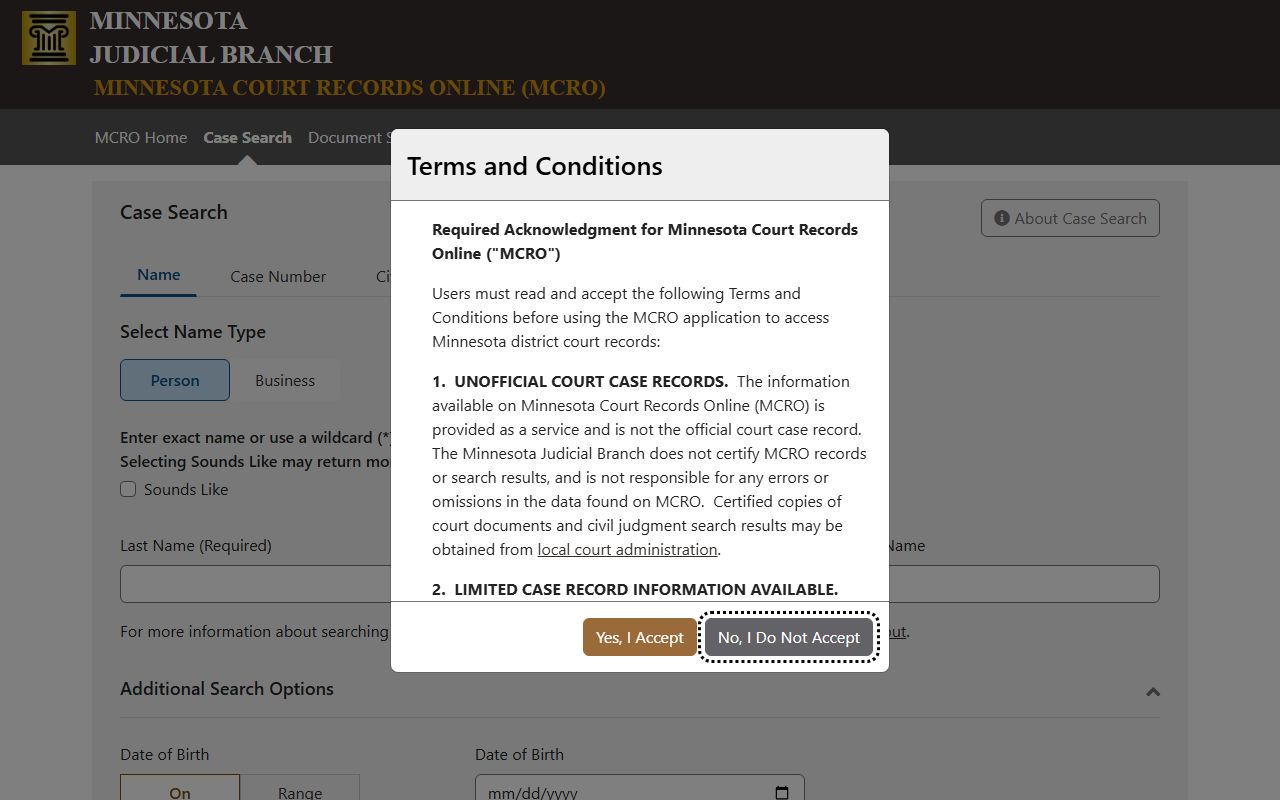
MCRO is statewide, so filtering by Clay County and checking case numbers helps avoid mixing defendants with similar names from other Minnesota counties.
Clay County Court Search Fields
The research captured the MCRO fields most relevant to court records after a jail arrest. The portal is broader than criminal cases, so the selected tab and county filter matter. When a case number is known from jail or court paperwork, it is usually more precise than a name search.
| Field Label | Type | Required | Notes |
|---|---|---|---|
| Search tab | Tab | Yes | Case Search, Document Search, Hearing Search, or Judgment Search. |
| Name | Text | Conditional | Person, business, or attorney name depending on search mode. |
| Case Number | Text | Conditional | Use exact case number when known. |
| Citation Number | Text | Conditional | Useful for traffic or citation-based criminal cases. |
| Attorney Bar Number | Text | Conditional | Used for attorney searches. |
| County / Location | Dropdown/filter | Optional | Choose Clay County when possible. |
| Case Category / Type | Dropdown/filter | Optional | Use criminal or traffic where available. |
| Date Range | Date fields | Optional | Helpful for hearings and document searches. |
Clay County Charging Role
Minnesota counties use a County Attorney title rather than District Attorney. The Clay County Attorney's Office is the chief prosecutor for crimes that occur in the county. Official county materials identify Brian J. Melton as Clay County Attorney and list the office in the lower level of the Clay County Courthouse. The office prosecutes all felonies in Clay County and primarily handles gross misdemeanors. It also has prosecution contracts with Moorhead, Dilworth, Barnesville, Hawley, and Glyndon for misdemeanor matters.
That local role explains why a person arrested by a city police officer may still have a case filed by the Clay County Attorney. The court record after the jail arrest usually centers on the complaint and register of actions. The complaint is the core document for most felony and gross misdemeanor arrest-to-court research in Clay County.
The county provides a prosecution contact block on the official Clay County Attorney page.
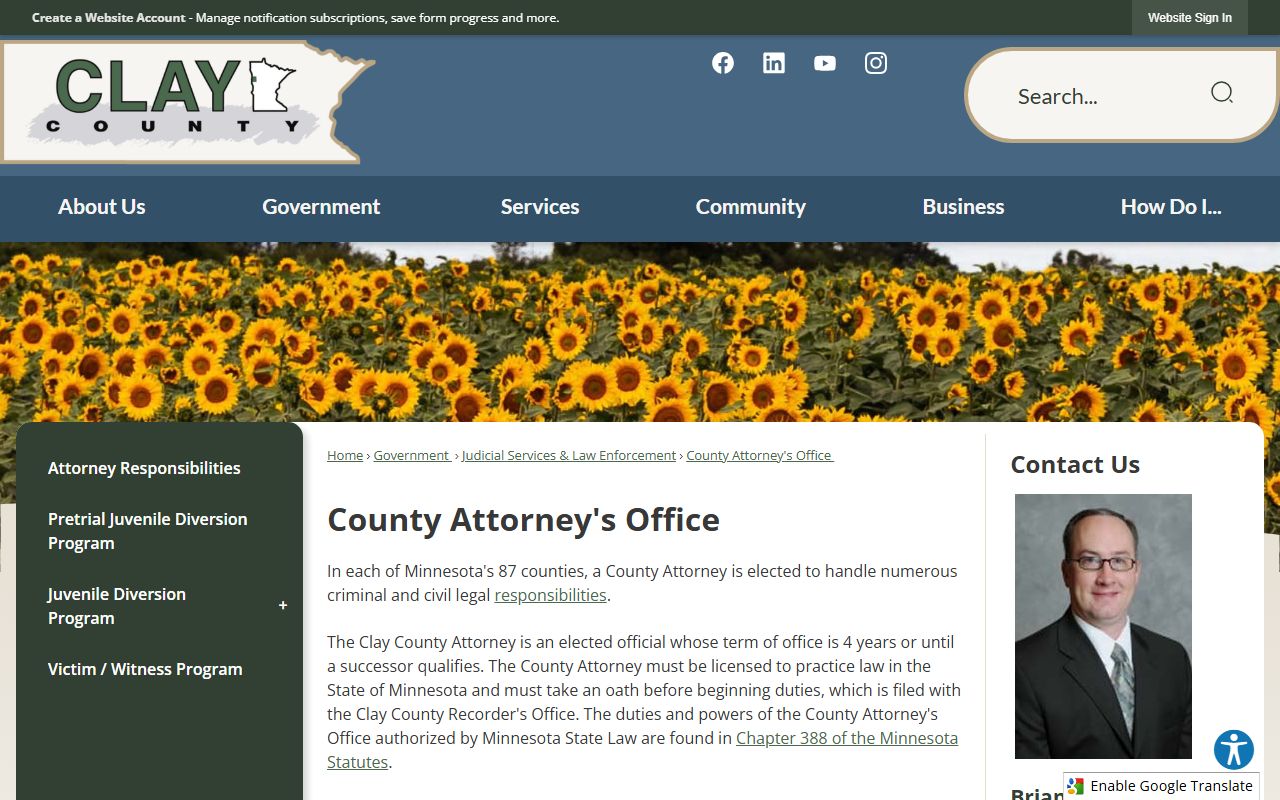
The Attorney page is useful for office identity and contact details, but it is not a substitute for MCRO, court administration, or legal counsel.
Clay County Charging Documents
Booking occurs at the jail, but a court case starts with a charging document. Minnesota felony and gross misdemeanor cases commonly proceed by complaint filed by the prosecutor. An information or indictment can be used in specific procedural contexts, but ordinary Clay County arrest-to-court research usually begins with the complaint, charge list, and register of actions in MCRO.
| Complaint | Information | Indictment | |
|---|---|---|---|
| Filed By | Prosecutor, based on law-enforcement reports and probable cause. | Prosecutor, in specific procedural settings. | Grand jury. |
| Common For | Most Clay County felony and gross misdemeanor starts. | Cases where law permits that filing route. | Serious cases or cases requiring grand-jury action. |
| Public Role | Shows allegations, statutes, counts, and probable-cause narrative when public. | States formal charges without the same ordinary use as a complaint. | States charges returned by the grand jury. |
| Research Use | Compare to jail booking charges. | Check with court administration or counsel if it appears. | Read with caution because access may be more limited. |
Clay County Charge Status
Court records after a jail arrest change as the case moves. A booking charge may be replaced by a formal charge. A formal charge may then be amended, reduced, dismissed, or resolved. The current status, not the first label, is the key field when reading a Clay County criminal case.
| Status | What It Means |
|---|---|
| Pending | The charge is unresolved and remains before the court. |
| Amended | The prosecutor or court process changed the charge, count, level, or wording. |
| Reduced | The charge moved to a lower level or lesser offense. |
| Dismissed | The charge ended without a conviction on that count. |
| Disposition | The formal case outcome, such as plea, verdict, dismissal, or sentence. |
| Convicted | The person was found guilty or entered a guilty plea on that charge. |
Clay County Bond Records
Bond can appear in the jail roster, the court case, or both. Clay County's bail page says bail may be posted in the public lobby of the Correctional Facility. The person posting bail presses the intercom, identifies the inmate and amount, waits for correctional staff instructions, and uses the Turnkey kiosk as directed. Clay County warns that release takes time after bail is posted because staff must complete multiple release steps.
| Bond Type | How It Works |
|---|---|
| Cash Bond | Money is posted to secure appearance in court under the order. |
| Surety Bond | A bonding company may be used if the court order allows that option. |
| Conditional Release | The court may release a person subject to rules such as no contact or testing. |
| PR / Own Recognizance | Release is based on a promise to appear, without a cash deposit. |
| No-Bond Hold | Payment will not produce release because a court or agency hold remains. |
Holds can include another county warrant, probation or parole hold, DOC hold, federal hold, or immigration detainer. Bond can also change after first appearance, so MCRO and the jail should be checked when timing matters.
Clay County Warrant Arrests
Clay County has a Warrants and Transport function, but no official public searchable warrant list was located in the reviewed county sources. When a warrant leads to arrest, the person may appear on the Clay County jail roster, and bench or failure-to-appear warrants often appear in the court register. The sheriff's office at 911 11th St. N. and the court administration phone line are practical starting points for process questions.
Warrant records may include a warrant number, case number, defendant name, date issued, issuing court, charge, warrant type, bail amount if set, and status. A warrant can require court appearance, counsel, judge action, or bond. It should not be treated as a simple phone correction.
Charges Versus Convictions
An arrest is not a conviction, and a charge is not a finding of guilt. Clay County's roster disclaimer says the information should not be relied on for legal action and that people may use false or incorrect identifying information. MCRO is the better place to track formal court status, but MCRO also warns that it should not be used as a background-check tool. Minnesota DPS/BCA is the proper public criminal-history source for that task.
| Charge | Conviction | |
|---|---|---|
| Stage | Accusation filed or pending in court. | Final guilt finding by plea or verdict. |
| Proof | Based on probable cause and charging standards. | Requires guilty plea or proof beyond reasonable doubt. |
| Record Use | Shows what was alleged and litigated. | Shows the final criminal-history result if public. |
| Can Change | Yes, it may be amended, reduced, or dismissed. | May later be appealed, vacated, or sealed if law allows. |
Sealed Versus Expunged Records
Minnesota expungement is governed by Minn. Stat. Chapter 609A. In practical terms, sealing limits public access to eligible records, but it does not always erase every government record or end every agency access rule. A dismissed case, acquittal, stay, diversion outcome, or old conviction may need separate eligibility review. Juvenile records and certain restricted data have their own rules.
| Sealed | Expunged | |
|---|---|---|
| Visibility | Hidden from ordinary public access. | Commonly used term for the court order sealing eligible records in Minnesota. |
| Agency Access | Some agencies may retain access under statute or court order. | Access depends on the order and governing Minnesota law. |
| Eligibility | Depends on case result, offense, waiting period, and statutory criteria. | Depends on Chapter 609A and the specific record sought to be sealed. |
| Where to Check | MCRO, court administration, and the expungement order. | Clay County District Court records and Minnesota expungement statutes. |
Restricted Clay Court Records
Not every record after an arrest is public online. Minn. Stat. 13.03 makes government data public unless a state or federal law classifies it otherwise. Minn. Stat. 13.82 governs law-enforcement data, including arrest and investigative data. Minn. Stat. 13.85 protects corrections and detention data when release would disclose medical, psychological, financial, unrelated personal, or safety-sensitive information. Juvenile records are especially limited and should not be treated like adult Clay County jail records.
For unavailable older records, contact Clay County Court Administration. For public sheriff or jail data not online, use the Clay County Data Practices process. Public requesters can inspect public data for free, ask for copies, or do both. Clay County's policy says it will notify the requester if it does not have the data, if the data is not public, or when public data can be inspected or copied.
Important: Non-official lookup results are not consumer reports and are not for FCRA-covered employment, housing, credit, or insurance decisions.